Contact Is Not Conversation
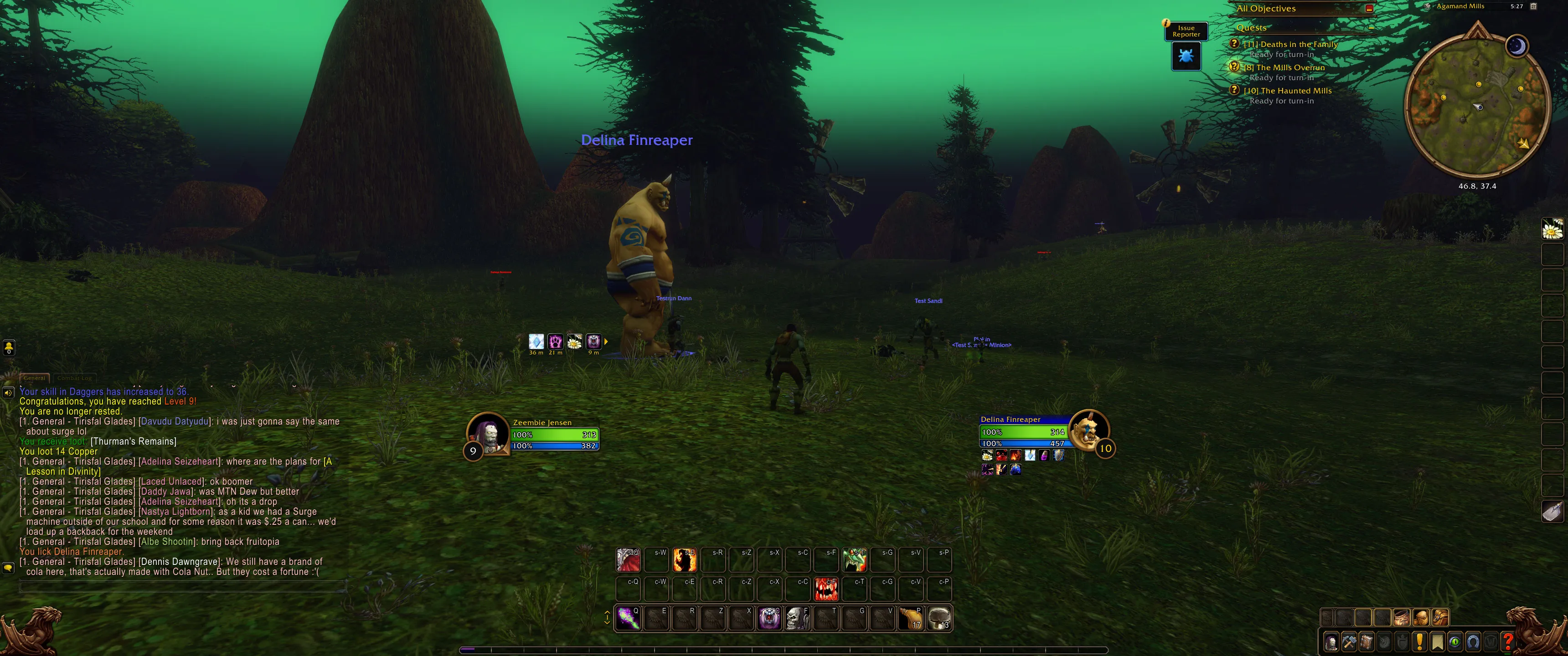
WoW Forever’s crowded quest mobs put strangers in the same group. Whether that makes them social is a different question.
A few days into the WoW Forever beta, players started asking Blizzard for shared mob tagging, the modern rule where everyone who hits a monster gets credit for killing it. Senior game designer Josh Greenfield said no, on X, and said it firmly. Shared tagging is “one of those things that we simply must hold the line on,” he wrote, because keeping some friction is, in his words, extremely important to the game’s social pillar. The logic is easy to follow. If five people need the same slow spawn, the efficient move is to form a group and split the credit, and forming a group is a social act.
I’ve watched that logic work, and I’ve watched where it stops. One quest in my own beta log, That Shadowvale Green Elixir, sent me down into a crypt in Tirisfal Glades for eight Bottles of Whispering Elixir. The bottles were scarce and the zombies around them were hard enough that fighting them alone was a gamble. So people grouped up, exactly as Greenfield intends. And the grouping went exactly as far as the elixirs did. Someone sends an invite. Nobody says anything. The mobs die, everyone loots, somebody types “ty,” and the group dissolves before the corpses fade. The quest sat in my log across five play sessions before I turned it in, and none of the groups I joined for it turned into anything beyond the elixirs. The scarcity did exactly what it was built to do. It put strangers in the same party. It did not connect them.
So is the beta evidence that scarcity and difficulty make players more sociable, or evidence that it only looks that way? My answer is that both observations are right, and an essay written twenty years ago explains why they don’t contradict each other.
Teamwork is not socializing
Raph Koster, the lead designer of Star Wars Galaxies and author of A Theory of Fun, wrote an essay in 2005 called “Forcing Interaction” about exactly this problem. His central line is blunt. Forced grouping does not force socialization, “it forces teamwork, and they are not the same thing.”
His explanation is about attention, not goodwill. A player only has so much mental capacity at any given moment, and during a fight all of it goes to the fight. Conversation happens in the troughs, the stretches before and after where nothing is demanding anything. A game that wants its players to become friends has to build those troughs deliberately, because the peaks will never produce them.
Koster learned this from his own game. Galaxies tried to push players into its cantinas with battle fatigue, a penalty that built up in combat and could only be cleared by player entertainers. Players mostly treated the cantina as a chore to get in and out of. Meanwhile, social hubs nobody designed grew up on their own at the starports, where people simply had to wait around. His diagnosis was that the game’s incentives punished anyone who stopped to talk, since talking earned less than fighting.
That gives a precise reading of the contested spawn. It is a peak, not a trough. Everyone in that group is watching a respawn point, a health bar, and a quest counter. The group exists to finish one task, and when the task is done, so is the reason to be there. Koster would not be surprised by “ty” and a disband. He would predict it.
What a wordless encounter can still do
The obvious objection is that silence doesn’t prove shallowness, and one game makes that objection well. In Journey (thatgamecompany, 2012), you share the desert with at most one other player at a time. There is no text chat and no voice chat, your companion’s name stays hidden until the credits, and the only way to communicate is a musical chime. It is about as wordless as an online encounter can be made.
But look at how the encounter is built. Most of Journey is walking, sliding, and climbing across open space with nothing attacking you, a long trough. The two players share a destination and have nothing to compete over. Standing close to your companion and chiming recharges each other’s scarf, which is what lets you fly, so staying together helps both of you and costs neither of you anything.
That’s the useful contrast. Journey shows that word count is the wrong way to measure an encounter, and it shows what the encounter needs instead, shared downtime and a relationship where one player’s gain isn’t the other’s loss. A contested spawn in WoW Forever is the opposite on both counts. It happens at the peak of attention, and it starts as a competition, since before the invite, the other player is the person about to take your kill. The game designer Daniel Cook, writing about prosocial multiplayer design, makes the general point directly. When strangers compete over a limited resource, they tend to hoard it, not share it. Grouping to split credit is a way out of that competition, and a sensible one, but it’s an exit from a conflict, not the start of a conversation.
What the beta actually shows
This isn’t a new pattern in WoW. In 2006, researchers from PARC and Stanford, Nicolas Ducheneaut, Nick Yee, Eric Nickell, and Robert Moore, published “Alone Together?”, built on months of data collected from live World of Warcraft servers. They found that grouping was an inefficient way to level, and that many players weren’t observed in a group at all until past level 55. That was the original game, with the same first-tag rules WoW Forever is now holding the line on. The friction existed then too. It didn’t turn leveling into a group activity on its own. The researchers’ reading was that much of WoW’s social pull came from being around other people rather than playing with them.
My own beta sessions fit that picture. Across everything I’ve played so far, grouping has worked as a tool and nothing more, a way to get the kill, the drop, or the quest credit sooner. Players behaved exactly the way an economist would predict. They grouped when grouping paid, split up the moment it stopped paying, and spent nothing on each other beyond what the exchange required. Nobody was being rude. They were being rational, and the game hadn’t given them a reason to be anything else.
The campfires are the part that surprised me, because they went the same way. In my first week of the beta I wrote, in an earlier piece on pacing, that the campfires I passed had real conversation around them. A few weeks in, that’s no longer what I see. WoW Forever’s camps are built by several players at once. Each nearby player can add one object from their profession to a fire, and anyone who sits beside it for a minute gets the camp’s buffs for an hour. Players have learned that rule. They walk up, sit for the minute, collect the hour, and leave. The one space the game built for slowing down has become another stop on the route.
This is Koster’s cantina again, almost exactly. A place meant for lingering was tied to a reward, so players did the minimum the reward asked for and nothing more. In Journey, staying close is the reward. At a Forever camp, the reward arrives at the one-minute mark, and every second after it costs leveling time and earns nothing. The first week’s conversations were probably what a new system looks like before anyone has worked out its best use. Koster describes that curve too, in A Theory of Fun. A pattern stays interesting only until the brain has solved it. Once “sit one minute, get one hour” was solved, the fire stopped being a place and became a transaction.
The strongest case against this
Greenfield has already answered a version of this argument. Replying to a player who made nearly the same point, he conceded that “that first interaction is probably you not talking too much,” and pointed to Recent Allies, a feature that gives players you’ve grouped with before a different colored name. The idea is that tomorrow, in another zone, you see that name again and recognize it, and the second invite isn’t between strangers anymore. On this reading, the silent first group isn’t the social payoff. It’s the seed. Judging it by how much gets said is like judging a friendship by the first handshake.
There is also a deeper objection to my own framing. I started out calling this sociability artificial, but all game sociability is designed. Guilds formed in 2004 partly because raids needed forty people. “Artificial” is not a criticism by itself.
I accept the second objection completely. The problem was never that the friction is designed, and “artificial” was the wrong word. The real question is whether a given design produces contact or conversation, and those are different outcomes.
The first objection is stronger, and I accept part of it. Recent Allies is a smart answer, because it targets the right problem, which is repetition. Friendships in games, as anywhere, mostly come from seeing the same people again. But the feature depends on meeting the same stranger twice, and the conditions that make a spawn contested, a crowded zone full of people on the same quest, are the same conditions that make any single stranger less likely to cross your path again. The more players competing, the more groups each person forms, and the less any one colored name stands out. There’s a second limit too. Recent Allies works by recognition, and where do you recognize the name? Most likely at the next contested spawn, which is another peak. It makes the second invite easier. It doesn’t create the trough where talking happens.
In my own play so far, the second encounter hasn’t come. I haven’t once seen a Recent Allies name come back after a group like the elixir ones. That’s one player in a crowded beta, so it doesn’t prove the feature fails. But it’s exactly the result the crowding argument predicts.
The last objection is about who’s playing. A beta is full of testers racing to see as much as they can before launch, not settled players building a home in the world. Rushing through groups and camps may say more about beta behavior than about the design. That’s partly fair, and it’s why this piece ends with a recheck after launch. But the design points the same way on its own. A camp that pays out in full after one minute tells every player, tester or not, that the second minute is worth nothing.
Verdict
The claim holds, and further than I expected when I started. Scarcity and difficulty in WoW Forever reliably make players group. They don’t, by themselves, make players sociable. The beta shows something sharper than that, too. Even the space built for slowing down gets optimized once it pays out on a timer. Greenfield is right that the friction is worth keeping. It’s the only system in the game that reliably introduces strangers to each other. But an introduction during a fight is one nobody has the attention to follow up on, and right now there’s nowhere in the game where following up doesn’t cost something.
My own position is that WoW Forever is heading somewhere good. Holding the line on tagging, and building Recent Allies to follow it up, shows a team that takes the social side of an MMO more seriously than most modern games do. But right now the design stops at the handshake. Players meet, trade help, and leave, because nothing gives them a reason to do anything else. I think the game should do more to turn those meetings into real social experiences.
The answer isn’t more friction. Koster’s argument cuts both ways. Pushing players together during a fight produces teamwork, and paying them to stop somewhere for a minute produces a stop on the route. What the game can reward instead is the stuff troughs are made of, time together, repetition, and recognition. Three suggestions, each scoped enough to act on.
- Let the group outlive the quest. Give a small bonus, experience or reputation, when the same group turns in more than one quest together. One shared quest is a transaction. Several in a row mean walking to the next objective together, waiting on the next spawn together, and the stretches in between, which is where Koster says conversation starts.
- Put socializing in the Legacy system. Rewards don’t have to be experience. WoW Forever’s Legacy system already grants account-wide progress for leveling classes, raising professions, PvP, exploring the world, and clearing dungeons and raids, and it’s the clearest statement the game makes about what it values. None of its challenges rewards coming back to the same people. A social category, for questing with a recent ally, building a camp with other players, or helping a lower-level player through a zone, would tell players that relationships count as progress too. And it would do it on a horizon far too long to farm in a minute.
- Give Recent Allies more colors. Right now a name is either colored or it isn’t. If the color deepened with every group you shared, someone you’ve quested with five times would stand out from someone you met once, and a familiar name would still catch your eye in a crowded zone, which is exactly where a single color gets lost.
Two of these are rewards, and rewards get optimized, as the one-minute camp shows. The question is what the optimal play produces. A bonus for a single kill produces a transaction. A bonus for staying grouped across several quests, or for coming back to the same people over weeks, produces time together and names that return, the conditions Koster says conversation needs. Players will still chase the reward. The difference is that this time the fastest route runs through the trough. A game can’t make strangers talk. It can make sure the best way to play keeps them together long enough to try.
Keep the friction. Then give the group a reason to still be a group after the monster is dead.
Worth rechecking after launch, when zones thin out and the same names start coming around more often. If groups and camps start turning into conversations on their own at that point, the problem was the beta, not the design.
Further reading
- Raph Koster, “Forcing Interaction” (raphkoster.com, 2005)
- Raph Koster, A Theory of Fun for Game Design (Paraglyph Press, 2004)
- Nicolas Ducheneaut, Nick Yee, Eric Nickell, Robert J. Moore, “Alone Together? Exploring the Social Dynamics of Massively Multiplayer Online Games” (CHI 2006)
- Daniel Cook, “Kind Games, Designing for Prosocial Multiplayer” (Lostgarden, 2023)
- Blizzard Entertainment, “Get to Know the World of Warcraft Forever Legacy System” (2026)
- Tyler Colp, “World of Warcraft Forever players competing over enemies is ‘extremely important’ to the experience, Blizzard says” (PC Gamer, 2026)
- Icy Veins, “Players Won’t Get Shared Mob Tagging in WoW Forever, but Blizzard Has a Plan” (2026)
Thoughts on this? Discuss it on the forum · Email me