The Quest Text Nobody Reads
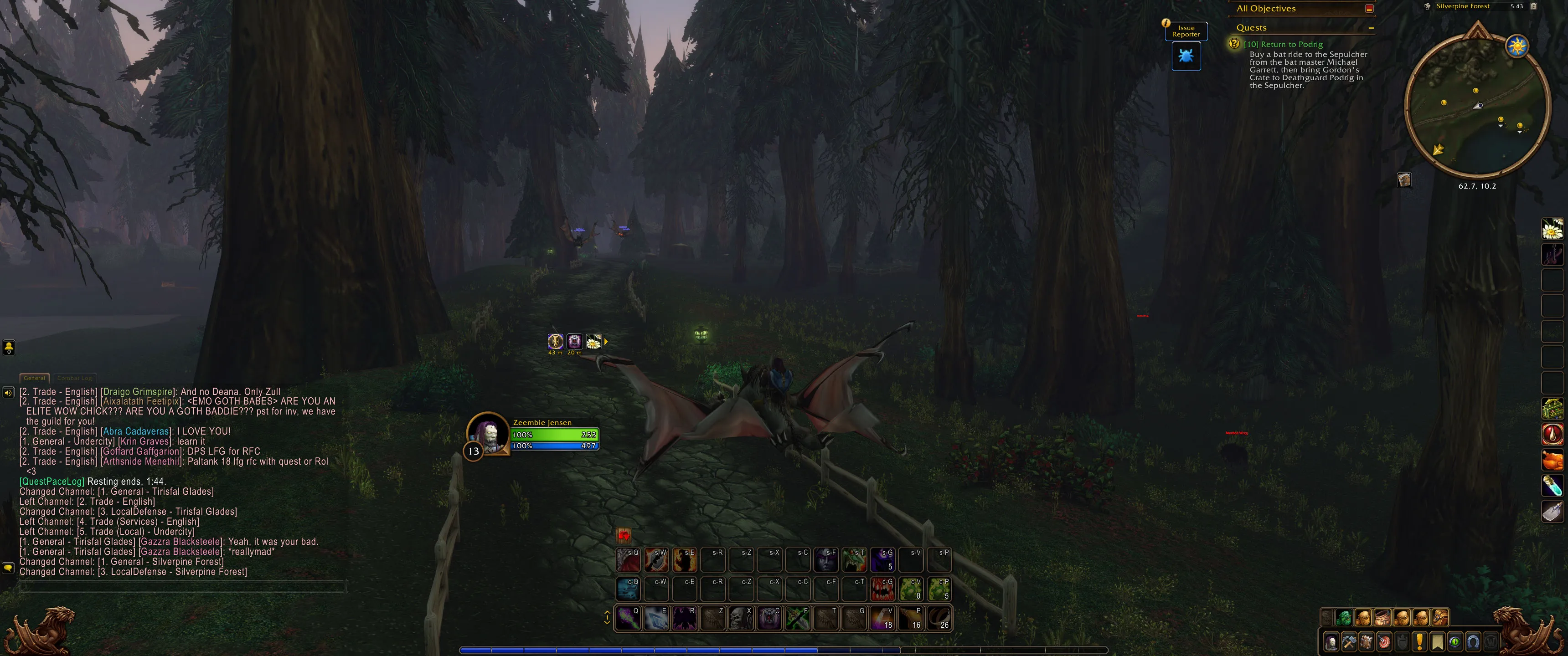
My first evening in Silverpine Forest, I took seven quests at the Sepulcher in under two minutes. A few days earlier I’d taken five in twenty-four seconds. I know this because I’ve been running a small addon in the WoW Forever beta that writes down, for my own character, the moment I accept and turn in every quest. Of my 105 accepted quests, 68 came within a minute of another one. When two accepts came within two minutes of each other, the median gap between them was nineteen seconds.
I’d like to say I read them. Most of them I didn’t. I accepted the quest, glanced at the one-line objective, and left. After a month of the beta, the only story I can tell you from start to finish is Thule Ravenclaw’s.
That’s a small confession about one player. It becomes a design problem because of what Forever is promising.
Why it matters at level 60
Lead Classic designer Tim Jones told Kotaku “we have a level 60 cap. We are going to continue to build content horizontally for players.” He framed the name itself as a promise that what you build on a character is a lasting investment. Clay Stone, associate production director, told Inven Global this week that horizontal mostly means “expanding the world itself horizontally,” with new zones, dungeons, raids and quests. Blizzard’s own summary of the plan says “leveling remains just as important as endgame,” and its Legacy system, account-wide progress meant to keep the journey rewarding “long after the first trip to maximum level,” openly encourages players to level more characters.
Put those together and the shape is clear. Everyone ends up at 60 and stays there, and many will walk the same 1 to 60 road again on an alt. At 60, nearly every leveling quest in the world is gray. My log suggests what gray means in practice. Quest rewards made up 57 percent of my experience, and of the 90 turn-ins where I know the quest’s level, not one was gray. When a quest stops paying, I stop doing it.
So after the cap, a quest has one thing left to offer, its story. And the story is the part I skip.
Embedded story and emergent story
Katie Salen and Eric Zimmerman’s Rules of Play separates two kinds of narrative in games. Embedded narrative is the authored content, written in advance and delivered to the player, like a cutscene or a block of quest text. Emergent narrative is the story that comes out of play itself, what happened to you, with whom, and how it went. A game can have plenty of the first and still leave players with only the second to remember.
That’s a fair description of my month. Forever’s quests are full of embedded narrative, and almost none of it reached me. What I remember is emergent, a group I joined, a place, a death, a head brought back.
What Hades does with the same problem
Hades, Supergiant’s roguelike, faced a harder version of this problem and solved it. A roguelike is built on repetition. You fight your way out of the underworld, die, and start again, dozens of times. Any story told the usual way would be skipped by the tenth run, the way I skip quest text by the tenth quest.
Hades never asks you to stop and read before you play. It puts its story where your attention already is. When a god offers you a boon mid-run, the power you actually want, the offer comes with a line about your choices or about the other gods. Every death sends you back to the House of Hades, and the characters there have something new to say, often about the run you just had, the weapon you carried or the boss who killed you. Each line is short and voiced, and none of it stands between you and the game. Supergiant counted more than 21,000 voiced lines in the game.
Creative director Greg Kasavin has described the reasoning. Even when a run resets, “you as a player still carry forward your knowledge,” so, as he put it, “why not have the characters acknowledge and be self aware of the cycle?” Repetition, the thing that should have killed the story, becomes how the story is told.
Hades is a single-player game with a fixed cast, and Forever can’t voice a thousand quests. The principle transfers anyway. Story lands when it’s attached to something the player already cares about, reacts to what they just did, and remembers.
Where Forever puts its story
Forever does the opposite. Its story sits in the accept window, a paragraph that stands between me and the task, at a quest hub where four other quests are waiting and I’m planning a route. Harvey Randall at PC Gamer praises exactly this part of Forever’s design, the need to “decide what the most efficient way to do these quests is with limited information.” He’s right that the planning is satisfying. But it means the story is delivered at the moment the game has trained me to think about efficiency, and the turn-in is no better, because by then the reward is already in my bags and the next quest is waiting.
The one piece of text I do read is the objective, the short line that stays on screen while I play. In the quests I remember least, that line carries no story at all. “Kill 8 Mindless Zombies and 8 Wretched Zombies.” “Collect 10 Doom Weed and deliver them back to Junior Apothecary Holland.” The paragraph I skipped may have explained who those zombies were. The line I read didn’t.
The Thule chain worked because its story didn’t depend on the text. My log shows it running across two evenings. Thule Ravenclaw sent me from Bethor Iceshard in Undercity’s Magic Quarter to the Sepulcher in Silverpine, Report to Hadrec passed me along, and Assault on Fenris Isle asked for Thule’s head. That last quest was level 24, red in my log, eight levels above me. I couldn’t do it alone, so I joined a group of strangers, crossed to Fenris Isle, died on the way, and came back with the head. The authored part gave me a name, a place across the water and a goal I could hold in one line, bring back Thule’s head. Everything I remember came from what I did with them. It was embedded story turning into emergent story, and it worked because the quest put me somewhere I had to act together with other people.
That’s the lesson I take from comparing the two. When Forever’s story works, it’s because the story is in the part of the quest I actually pay attention to, the goal, the place and the fight. When it fails, the story is in the paragraph I skip.
Players are already working on it
Some players haven’t waited for Blizzard. Immersion, an addon by MunkDev, replaces the quest and gossip windows with a dialogue-style frame that reads more like a conversation than a form. It lists Forever among the versions it supports and shows more than 8.3 million downloads on CurseForge across all versions of the game. AI VoiceOver, a community project for Classic, goes further. It gives quest and gossip text spoken voices generated with AI, so the quest giver actually talks to you. Both are impressive work, and I’d recommend trying them.
They also say two things about this problem. First, a lot of players do want the story, they just don’t want it as a paragraph in a form. (To be fair to my own argument, Immersion also lets you accept a quest with a single key, so it serves skimmers like me as well.) Second, they show how the Classic audience takes to change. Both are optional. Anyone who wants the 2004 quest window keeps it.
The strongest counterargument
Classic never needed players to read. Its story was the world itself, the zones, the music, the names on the map, and the text was there for those who wanted it. Plenty of players do read every word, and maybe my skimming says more about me than about the design. Blizzard’s own framing points that way too. Its deep dive presents Azeroth as the story, with every road, campfire and dungeon part of it. And the obvious fix, voiced cutscenes or talking heads, would pull Forever toward the modern game its players chose to leave.
I grant most of this. I don’t want cutscenes in Forever, and a world that tells its story through places is one of Classic’s real strengths. This is the hard balance Forever lives with. Its players chose it because it’s Classic, and they accept something new when it feels like Classic or when it’s optional, the way the addons above are. That’s the test I’ve tried to hold my suggestions to. But the counterargument also describes a game where reading is optional because experience points carry you forward either way. Forever is about to become a game where, at 60, experience points carry nobody anywhere. Then the quest’s story is no longer a bonus for the curious. It’s the main reason the quest exists. And for players replaying on an alt, the very group the Legacy system courts, skipping text is the norm, not the exception.
What I’d change
Three changes, all text-only, and all built on things the game already has, the objective line, the world and the Legacy system.
- Write the story into the objective. The objective is the only text every player reads, and it stays on screen for the whole quest. “Kill 8 Mindless Zombies” could say who those zombies were and why it matters, in the same single line. That’s the Hades approach, story attached to the thing the player is already looking at.
- Let the world speak during the task. A short line from the target when you arrive, a note on a body, a reaction when the objective completes. Hades talks to you while you play, not before. Classic already does this in places, and the one chain I remember from this beta told its story through a place and a fight, not a paragraph.
- Give story chains a place in Legacy, and let the account remember. The Adventure category has two challenges, exploring the whole world map and the Lord Valthalak questline. Add challenges for completing a zone’s story chains, on any character, at any level, gray quests included. That gives a level 60 a real incentive to walk back to the Sepulcher for Thule, one that doesn’t depend on experience. And since Legacy is account-wide, a quest giver could recognize, in a single line, that the account has done this chain before. Hades makes the cycle part of the story. Forever’s cycle is the alt, and right now it’s invisible.
Verdict
Forever’s leveling quests will keep their value after the cap only if their stories land, and in my beta they mostly don’t, because the story sits in the accept window, the text I’m least likely to read. The one chain that stayed with me worked because its story lived in the goal, the place and the fight. The limit is that this is one player’s habit. My addon can see how fast I accept quests but not what I read, the gaps include walking between quest givers, and some players read everything. But a game built to be played at 60 forever can’t count on the players who read. It has to reach the ones who don’t.
Further reading
- Katie Salen and Eric Zimmerman, Rules of Play, Game Design Fundamentals (MIT Press, 2003), on embedded and emergent narrative
- Jini Maxwell, “Hades’ Greg Kasavin breaks down Supergiant’s unique approach to narrative” (ScreenHub, 2021)
- Nintendo Wire, “Hades has over 300,000 words of voiced dialogue” (2020), reporting Supergiant’s own count
- MunkDev, Immersion (CurseForge)
- AI VoiceOver (GitHub), and its Classic Era update VoiceOver Continued (CurseForge)
- Rebekah Valentine, “8 New Things We Learned About World Of Warcraft: Forever” (Kotaku, September 14, 2026)
- Inven Global, “Post-Beta ‘WoW: Forever’, What Is the Development Direction?” (October 8, 2026)
- Blizzard, “Get to Know the World of Warcraft: Forever Legacy System”
- Blizzard, “World of Warcraft: Forever Deep Dive Panel Recap”
- Blizzard, “World of Warcraft: Forever What’s Next Panel Recap”
- Harvey Randall, “World of Warcraft: Forever’s convinced me that we lost too much to modern MMO quest design” (PC Gamer, September 19, 2026)
Thoughts on this? Discuss it on the forum · Email me