The Rules Blizzard Wrote for Itself
Most studios talk about design pillars. Few promise to be held to them. In October, the WoW Forever team told TechRadar that they “weigh decisions we make against those pillars and if the idea doesn’t support them, we don’t do it.”
That’s a strong promise, and it makes the pillars worth knowing in detail. But Blizzard has never published them, with the rules behind them, in a single place. The pillars were announced at BlizzCon in September. The rules that make them concrete came out piece by piece, in panel recaps, interviews and developer posts over the following five weeks.
This article puts them together. Four pillars, 22 rules, and where each one comes from. The rules are Blizzard’s words. The grouping and the short codes (S1, W2 and so on) are mine, so the figures and the text can refer to them quickly.
Four pillars and a decision rule
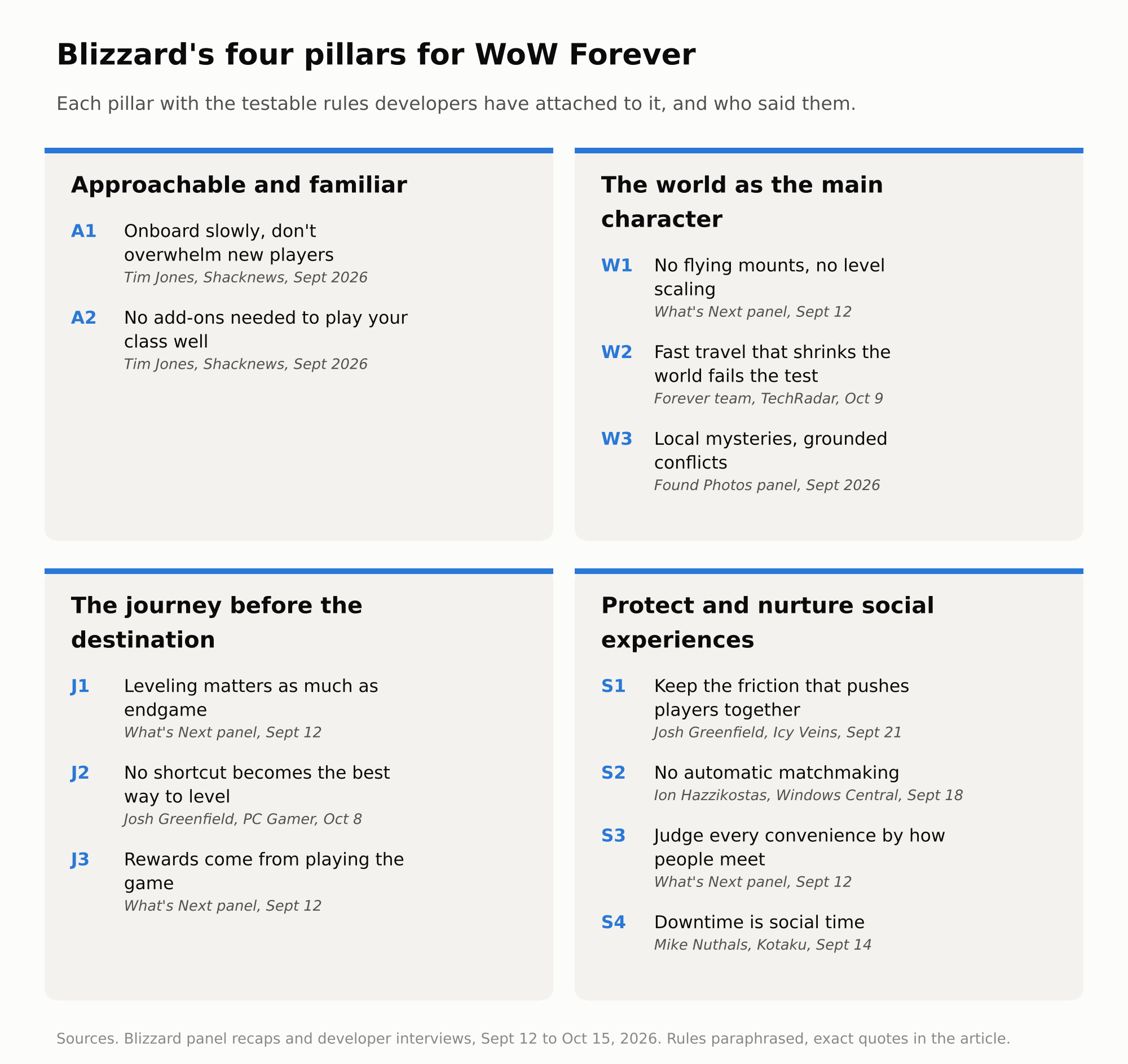
Blizzard’s What’s Next panel recap lists them in one sentence. “Four core pillars guide the experience” (approachable and familiar, the world as the main character, the journey before the destination, and protecting and nurturing social experiences).
A pillar on its own can’t be checked. “The journey matters” fits almost any change. What makes Forever’s pillars useful is that developers kept explaining decisions with them, and each explanation adds a narrower rule that can be checked. The first figure shows the four pillars and the rules attached to each.
Approachable and familiar
This is the pillar with the least behind it. Both of its rules come from one interview, Tim Jones talking to Shacknews in September.
- A1, onboard slowly. “We want the leveling journey to take a long time, but slowly onboard people into complexity and not overwhelm them.”
- A2, no add-ons required. Jones said the team doesn’t think “it’s necessary for people to have to have add-ons in order to be able to play their class correctly.”
The world as the main character
This pillar is about scale and distance. The world should feel big, dangerous and worth exploring, and things that make it smaller are suspect.
- W1, no flying and no level scaling. The What’s Next recap says “You’ll feel that philosophy throughout the world,” naming “no flying mounts, no level scaling, and a continued focus on challenge, preparation, communication, and cooperation.”
- W2, fast travel shrinks the world. Asked why Forever has no summoning stones, the team told TechRadar “Easy, quick access to teleports shrink the world.”
- W3, look inward, not outward. The Found Photos panel, presented by Josh Greenfield and Evan Lee, describes new content where “The philosophy favors local mysteries, grounded conflicts, and underused characters.” The What’s Next recap says the same thing in one line. “Rather than looking away from Azeroth, we’re looking deeper into it.”
The journey before the destination
This is the pillar behind Forever’s pace. Blizzard’s announcement post, “Carve a New Path,” said “the journey matters as much as the destination.”
- J1, leveling matters as much as endgame. From the What’s Next recap. “That means leveling remains just as important as endgame, effort continues to matter, and rewards come from playing the game.”
- J2, no shortcut becomes the best way to level. When dungeons turned out to be the fastest way to level in the beta, senior game designer Josh Greenfield explained the experience cut in a post quoted by PC Gamer. “That playstyle being the optimal way to level does not pass that muster.”
- J3, rewards come from playing. The last part of the J1 sentence. Progress should come from what players do in the world, not from shortcuts around it.
Protect and nurture social experiences
This pillar has the most rules, and the most direct quotes. It’s also the one players argue about most, because it defends things many people find annoying.
- S1, keep some friction. On shared mob tagging, Greenfield wrote, in a post reported by Icy Veins, “it is extremely important to our social pillar to maintain some of this friction.”
- S2, no automatic matchmaking. Senior game director Ion Hazzikostas told Windows Central “The presence of friction, the lack of automatic matchmaking … that lends itself to establishing social connections.”
- S3, judge every convenience by how people meet. The What’s Next recap. “We’re also being thoughtful about convenience, because every quality-of-life choice can shape the way players meet, gather, and make memories together.”
- S4, downtime is social time. Mike Nuthals told Kotaku “those moments of downtime are important for social opportunities.”
The Deep Dive panel recap sums up the idea behind all four. “A core foundation of World of Warcraft: Forever is serendipitous interactions.”
The rules beyond the pillars
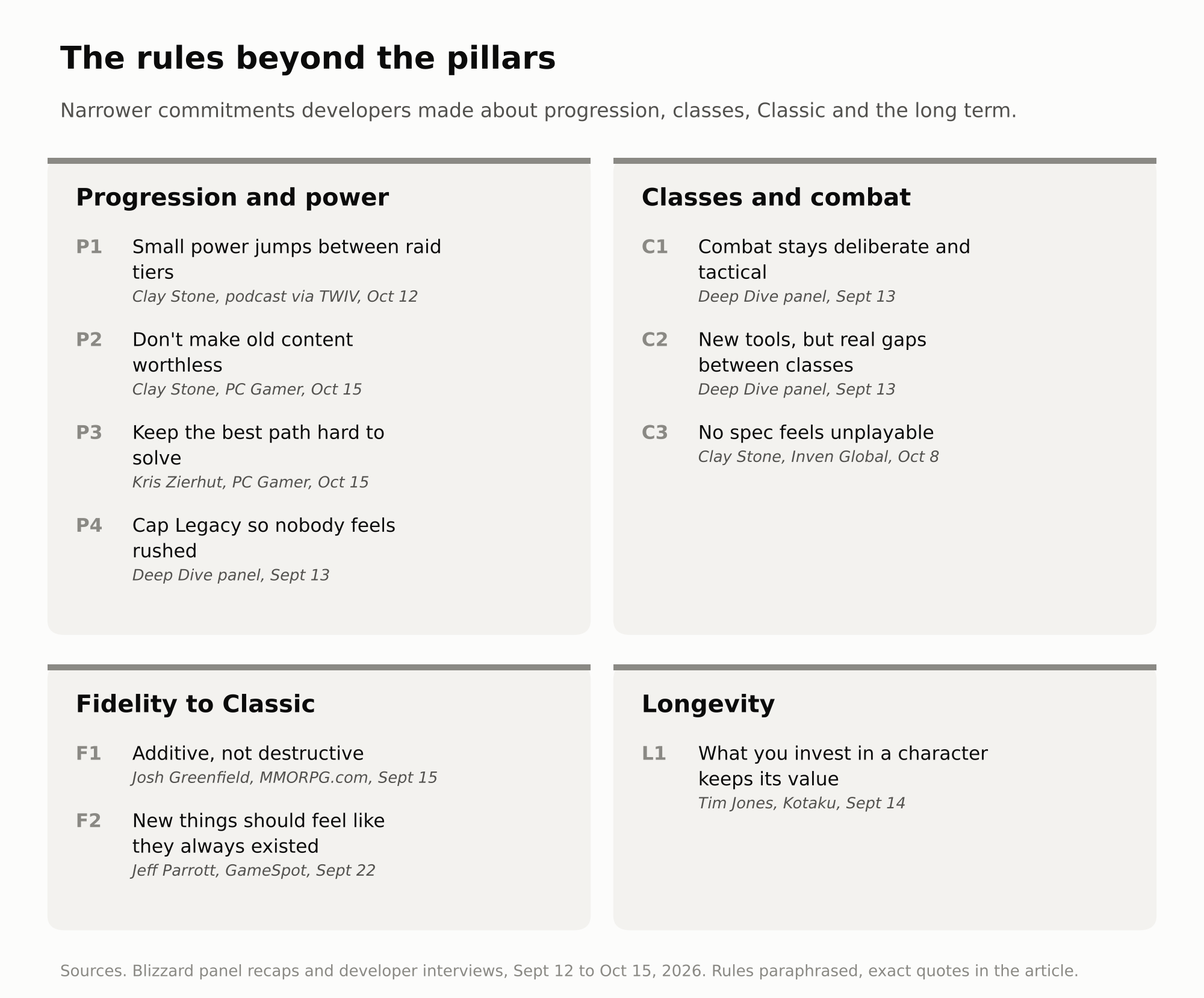
Some of the clearest commitments don’t fit neatly under a pillar. They are about power, classes, how much Forever may change Classic, and what a character is worth in the long run. I group them in four areas, shown in the second figure.
Progression and power
- P1, small power jumps. Associate production director Clay Stone, on a podcast reported by This Week in Videogames. “There will be a little bit of vertical power progression that happens between each of the raid tiers, but we’re going to try to keep it as small as possible.”
- P2, old content stays relevant. Stone again, to PC Gamer. “It’s very much our intention to try wherever we can to not invalidate old content.”
- P3, keep the game unsolved. Kris Zierhut, in the same PC Gamer piece. “The goal is to un-solve the game, so players have to figure out again what’s the best path.”
- P4, cap Legacy. From the Deep Dive recap, on the account-wide Legacy system. “The cap is intended to keep players from feeling pressured to do everything at once.”
Classes and combat
- C1, combat stays deliberate. The Deep Dive recap says changes should “preserve what makes it deliberate, tactical, and class-driven.”
- C2, real gaps between classes. Also from the Deep Dive, the goal is to “give each specialization new tools while preserving meaningful gaps in the class toolkit.”
- C3, no useless specs. Stone, to Inven Global. “One of our key goals in ‘WoW: Forever’ is to ensure that no spec feels unplayable or useless.” In the same interview he described “the overall philosophy is to maintain distinct class identities and avoid homogenization.”
Fidelity to Classic
- F1, additive, not destructive. Greenfield, to MMORPG.com. “We want to, generally, be additive and not destructive to almost anything we’re doing.”
- F2, new things should feel old. Jeff Parrott, to GameSpot. “If a player asks, ‘Did this exist in the game?’ then I think we’re in a good spot.”
Longevity
- L1, your investment keeps its value. Jones told Kotaku that Forever is meant to be “a safe place to make a character where everything that you invest your time in will matter forever.” The name of the game is the rule.
Where the rules come from
The third figure puts every source on a timeline. It shows something the lists hide.
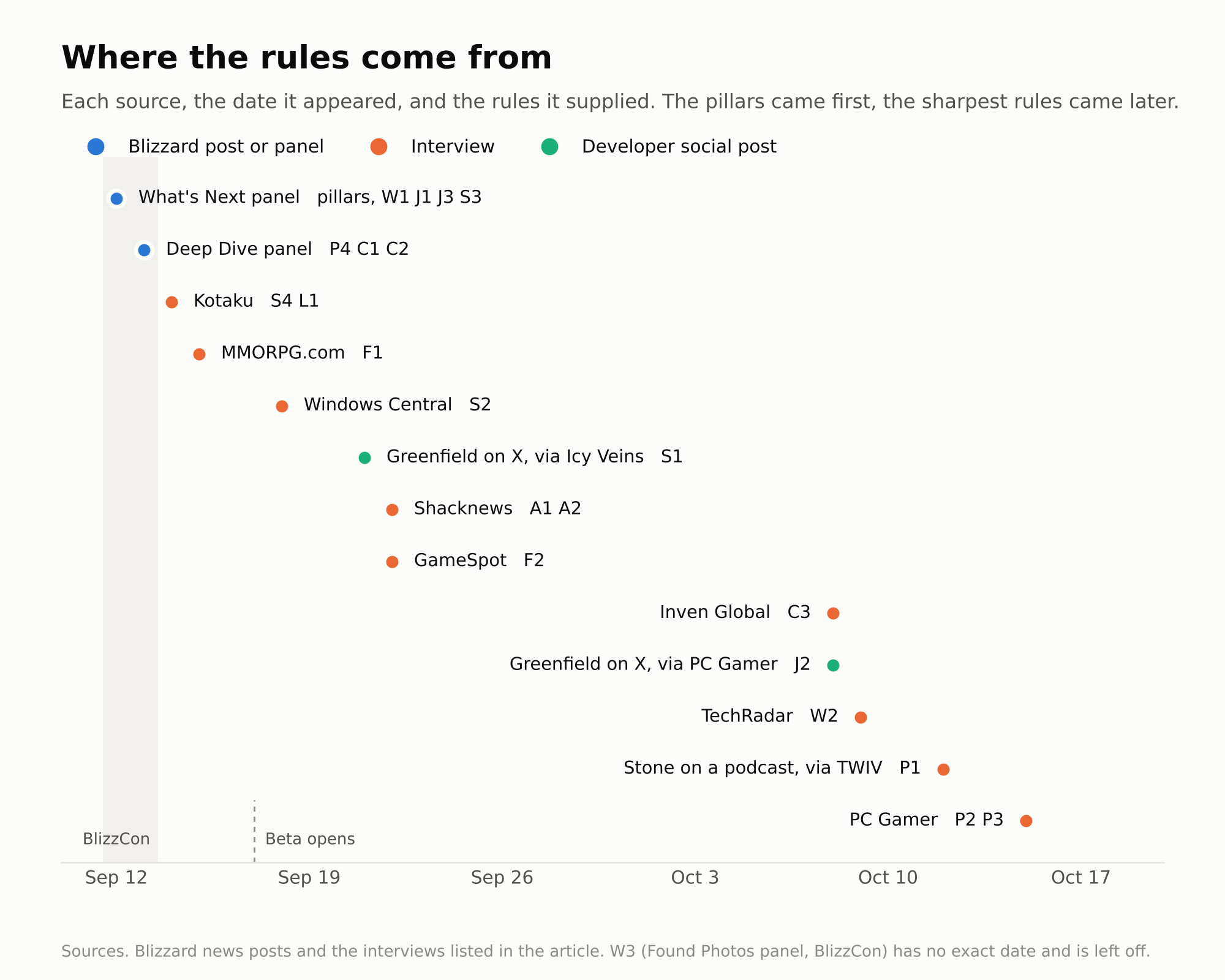
Only eight of the 22 rules come from Blizzard’s own posts, the What’s Next, Deep Dive and Found Photos recaps published at BlizzCon. The other fourteen come from interviews with the press and from developers posting on social media. If you only read Blizzard’s news site, you’d know the pillars but miss most of the rules.
The timing matters too. The pillars came first, all at once, at BlizzCon on September 12 and 13. The sharpest rules came later, and most of them came in response to something players were angry about in the beta.
- S1 arrived on September 21, as players asked for shared mob tagging.
- J2 arrived on October 8, after dungeons became the fastest way to level and Blizzard cut their experience.
- W2 arrived on October 9, when players asked why Forever has no summoning stones.
- P1 arrived on October 12, after confusion over whether Forever’s progression would be “horizontal.”
That’s how design principles usually work in practice. A team states its values broadly, then makes them concrete when a real decision tests them. It also means the list isn’t finished. Every controversy in the next months is likely to add a rule, and every rule added in defense of a decision should be read with that in mind.
Where the rules pull against each other
Pillars collide, and Blizzard has never said which one wins. A few tensions are already visible.
Approachable against social. A1 and A2 want a game that doesn’t overwhelm new players. S1 and S2 defend friction that new players are the most likely to find frustrating, like competing for mobs and building groups by hand.
Classes against fidelity. C3 promises that no spec will feel useless. F2 promises that changes will feel like they always existed. In Classic, many specs were close to useless, so keeping C3 means changing things players remember.
Journey against social. Cutting dungeon experience (J2) protected the journey, but dungeons are one of the most social things a leveling player does. In that case the journey won over the social pillar.
The pillars tell you what Blizzard values. The rules tell you how those values become decisions. Which pillar wins when two of them collide is the part Blizzard hasn’t written down yet.
Further reading
- Blizzard, What’s Next panel recap, Deep Dive panel recap, Found Photos panel recap, “Carve a New Path” and the Legacy system
- TechRadar, the Forever team on its design pillars (October 8, 2026) and on summoning stones (October 9, 2026)
- Shacknews, “World of Warcraft: Forever is not a remake” (September 2026)
- Kotaku, “8 New Things We Learned About World Of Warcraft: Forever” (September 14, 2026)
- MMORPG.com, BlizzCon 2026 interview (September 15, 2026)
- Windows Central, interview with Ion Hazzikostas (September 2026)
- Icy Veins, on shared tagging (September 21, 2026)
- GameSpot, “WoW Forever aspires to have a Mandela effect on players” (September 22, 2026)
- Inven Global, interview with Holly Longdale and Clay Stone (October 8, 2026)
- PC Gamer, on dungeon leveling (October 8, 2026) and on gear staying relevant (October 15, 2026)
- This Week in Videogames, Clay Stone on raid power jumps (October 12, 2026)
Thoughts on this? Email me