Slow on Purpose
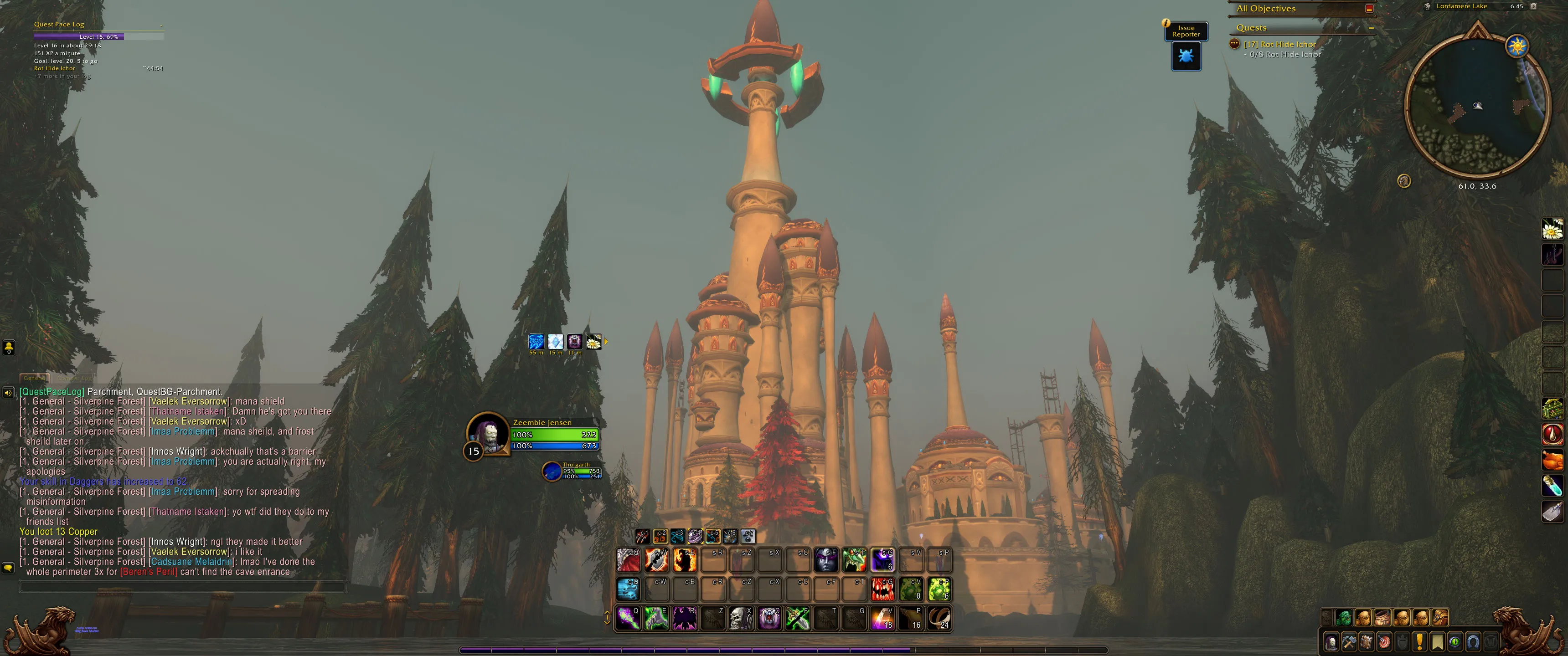
It took me about ten and a half hours of play in the WoW Forever beta to reach level 16. Levels 14 and 15 took about an hour and a half each, and level 16 took more than two and a half. That’s not an accident or a balance problem. Blizzard’s lead Classic designer, Tim Jones, told Shacknews “We want the leveling journey to take a long time, but slowly onboard people into complexity and not overwhelm them.”
Blizzard explains Forever’s pace in design terms, and the explanation holds up. But World of Warcraft earns most of its money from monthly subscriptions, and a slower game is also a game people stay subscribed to for longer. This piece looks at both reasons side by side. I’m not claiming Blizzard slowed Forever to sell subscriptions. I’m arguing that in Forever, the design case and the business case point in exactly the same direction, and that this alignment explains a lot about the game.
The problem every MMO has
Raph Koster, lead designer of Ultima Online and creative director of Star Wars Galaxies, described the basic math in a mailing-list post now reprinted on his site. “A quest that takes 3 weeks to write, implement, and test takes a couple of hours to beat.” And the more players a game has, the faster they burn through it, because “cheat websites ensure that content is consumed faster and faster.” The collection of laws for online worlds that he keeps puts it more bluntly. “Mathematically, it is not possible for a design team to create stories fast enough to supply everyone playing.”
For a subscription game, that math is the whole business problem. A player pays for months, not for content. Every week a player spends with nothing left to do is a week they might cancel. A team can respond in two ways, make content faster or make each piece of content last longer. Forever leans hard on the second.
What WoW’s own numbers show
Blizzard hasn’t published a WoW player count since 2015. Outside data is patchy, but it shows the problem a slower game is meant to solve. Players drift away as they run out of things to do, and some versions lose most of their players while others keep them.
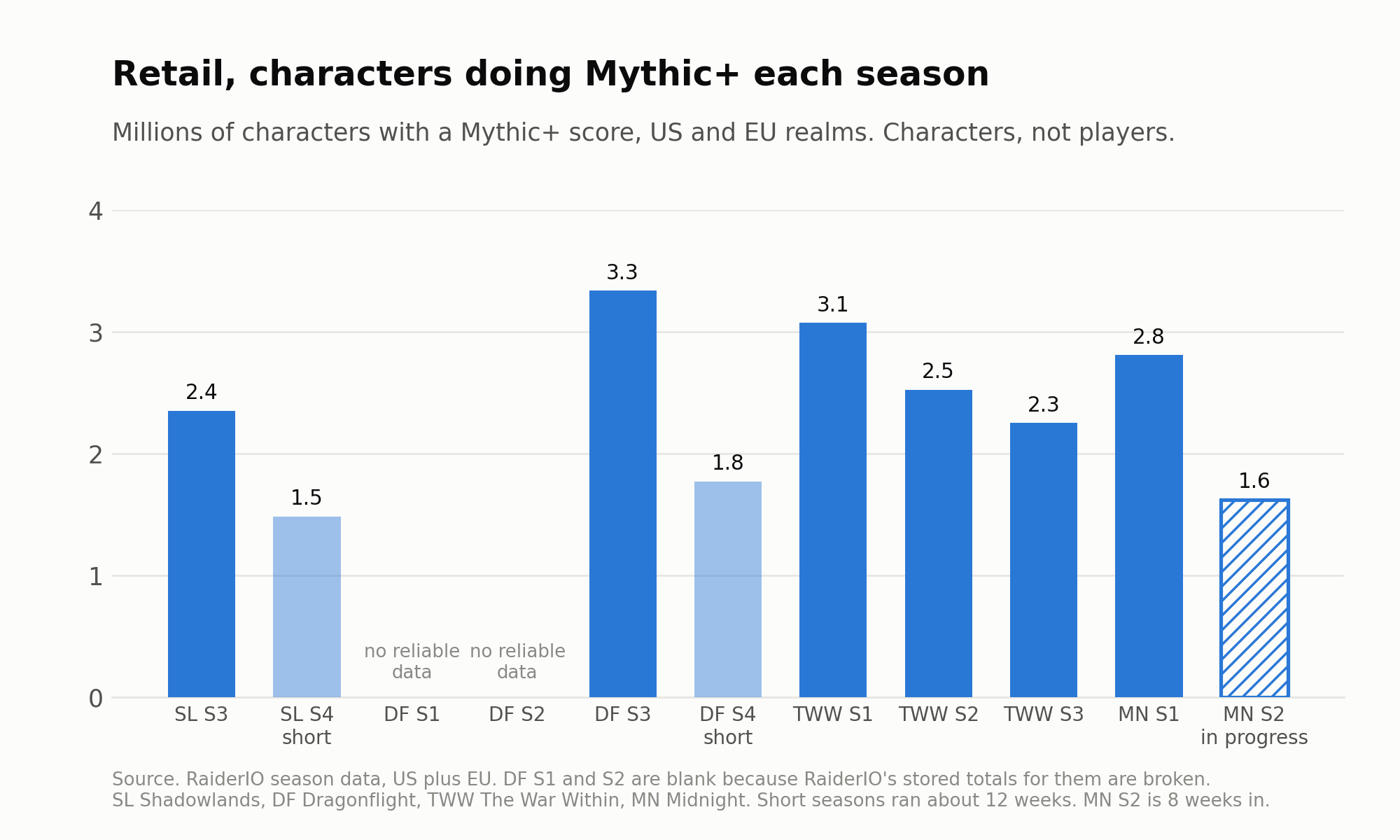
In Retail, RaiderIO counted about 3.1 million characters doing Mythic+ on US and EU realms in The War Within’s first season, then 2.5 million, then 2.3 million, before Midnight’s first season brought the number back up to 2.8 million. The pattern isn’t clean everywhere. Dragonflight’s third season was the biggest of all at 3.3 million, and RaiderIO’s stored totals for that expansion’s first two seasons are broken, so I can’t say whether it started even higher.
Classic shows the range more clearly. By Warcraft Logs data reported by Wowhead, original Classic peaked at about 241,000 raiding characters and still had 215,000 in its final week. Burning Crusade Classic went from 356,000 to 257,000. Wrath of the Lich King Classic peaked at 623,000 and ended at 50,000, and Cataclysm Classic fell from 301,000 to 62,000. (Wowhead doesn’t define the final week, which likely includes players leaving for the next version.) Season of Discovery peaked at about 496,000 in January 2024 and was down to about 75,000 by March 2025. Holding players is possible, and losing most of them is common. Forever is betting it can be the first kind.
Blizzard tracks exactly this. In early 2023, Activision Blizzard told investors that Dragonflight’s sales had not matched the previous expansion, but that “post-launch subscriber retention in the West is higher than recent expansions.” Retention, not launch numbers, was the good news worth reporting.
How Forever slows the clock
Look at Forever’s systems with that curve in mind, and nearly every major decision stretches the time between “I’m done” moments.
- Leveling takes longer. Jones wants the journey “to take a long time.” Over 1,000 new quests fill the 1 to 60 road, and when dungeons turned out to be the fastest way to level, Blizzard cut dungeon quest experience. Josh Greenfield, senior game designer, said that playstyle “being the optimal way to level does not pass that muster.”
- Raids open after launch. Forever launches on November 4, and its first raids unlock on December 9, five weeks later. The next raids are planned for spring 2027 and summer 2027.
- Gear jumps are kept small. Associate production director Clay Stone said Blizzard wants to keep the power gain between raid tiers “as small as possible,” and to avoid making old content worthless. In Retail, by contrast, senior game director Ion Hazzikostas told Warcraft Tavern “You probably are going to finish the expansion three to four times stronger than you were when you entered it.”
- Legacy is capped on purpose. Forever’s account-wide Legacy system caps how many points each character can spend. Blizzard’s deep dive says “the cap is intended to keep players from feeling pressured to do everything at once,” and promises the system will keep the journey rewarding “long after the first trip to maximum level.”
- It sits inside the same subscription. Apart from an optional paid race, Forever needs no purchase beyond the usual WoW subscription. Hazzikostas called this “another strength of the way WoW exists today,” since one subscription covers Retail, Classic and Forever.
Every item on that list has a design reason in Blizzard’s own pillars, especially “the journey before the destination.” And every item also lengthens the time a player spends between launch and the point where nothing is left.
Where design and business meet
Executive producer Holly Longdale described the philosophy behind this to Warcraft Tavern. Players, she said, are not “served by very snackable, brief experiences because WoW is an investment.” Hazzikostas called Forever an ideal entry point “just because of the pace.”
That word, investment, is where the two reasons meet. In design terms, a slow journey gives each level and each piece of gear more meaning. Jones describes the name itself as a promise that Forever is “a safe place to make a character where everything that you invest your time in will matter forever.” In business terms, an investment is something you keep paying into. A player halfway to 60, or a guild halfway through a raid that won’t be replaced for months, has a reason to renew.
Raph Koster’s math suggests why this matters more for Forever than for Retail. Forever has no expansions planned to raise the level cap. It can’t reset everyone with a new continent every two years. If its content is consumed at Retail speed, its own name becomes a problem. Slowing the clock is the only way a game called Forever can stretch a year of content across a year of subscriptions.
The strongest counterargument
Slow is not the same as sticky. Players don’t stay subscribed because a game is long. They stay because the time feels worth it, and a slow game can just as easily push people out. My own beta log shows the risk. About half of the quests I turned in had been picked up in an earlier session, so on a short evening I was often finishing old work instead of starting anything new. A player with short evenings can feel that slowness as a growing backlog, not as a meaningful journey. Hazzikostas said it himself. “People make time for what they prioritize and what they value, and what they feel is worth their time.”
There’s also a fair point that Classic players asked for this. Forever’s pace is close to the 2004 game its audience loved, not a new trick. And Retail also stretches time, through weekly lockouts and seasonal resets. Slowing content is not unique to Forever.
I grant all of this. The claim isn’t that slow equals profitable, or that Blizzard is being cynical. It’s that Forever is the clearest case of a design philosophy and a revenue model reinforcing each other. That matters, because when design and business agree, the design rarely gets questioned. The real test is whether Forever’s slowness keeps players engaged or only keeps them busy.
What to watch after launch
The test is the same curve as above. If Forever’s slower pace works, its raid participation after December 9 should fall more gently than Wrath and Cataclysm Classic did, and it should hold up better between tiers than Retail’s seasons. If it falls just as steeply, then slowness alone didn’t change player behavior, and the design will need more than time to keep people around.
I’ll track it, and I’ll report what the numbers show, whichever way they go.
Further reading
- Raph Koster, post on content creation and consumption (MUD-Dev, reprinted on raphkoster.com) and Laws of Online World Design
- Shacknews, “World of Warcraft: Forever is not a remake” (September 2026)
- Warcraft Tavern, “Exclusive Ion & Holly Interview at BlizzCon 2026” (September 2026)
- Kotaku, “8 New Things We Learned About World Of Warcraft: Forever” (September 14, 2026)
- PC Gamer, on dungeon leveling (October 8, 2026)
- This Week in Videogames, Clay Stone on raid power jumps (October 12, 2026)
- Icy Veins, raids every tier and roadmap
- Blizzard, Deep Dive panel recap and Legacy System
- Blizzard Watch, how much WoW Forever costs (September 13, 2026)
- Activision Blizzard, Q4 2022 results
- RaiderIO, Mythic+ cutoff pages, which list each season’s character population (season and region are set in the page address)
- Wowhead, “Are There Too Many Versions of WoW? Classic Week 2 Raiding Numbers Lowest Since The Burning Crusade” (August 17, 2025) and on Season of Discovery
Thoughts on this? Email me